
Why Your Medspa Clients Are Ecstatic And Never Come Back
Why Your Medspa Clients Are Ecstatic And Never Come Back
She left a 5-star review.
Told your provider it was the best treatment she'd ever had. Posted about it on her stories. You saw the tag. Felt good about it.
And she never came back.
This is not a rare story. It's the most common story in medspas right now, and most owners have no idea why it keeps happening.
The Happy Client Who Disappears
Here's the thing about client satisfaction scores: they don't measure rebooking intent. They measure how someone felt walking out the door. Those are two different numbers. Confusing them is costing you revenue you've already earned.
Your client left happy. She had a real result. She's not avoiding you because something went wrong. She's not at a competitor's clinic. She just moved on. Got busy. Meant to call back when she needed it. And the moment passed.
This is the most expensive kind of churn because it's invisible. You never see a cancellation. There's no complaint to fix. The client just doesn't appear in your calendar again, and three months later you're wondering why your retention number looks the way it does.
According to data from workee.ai, the average med spa runs a 47% retention rate. That means more than half the clients who come in once don't come back. And most of them aren't upset. They're satisfied. They just weren't asked to come back at the right moment, in the right way.
Think about the math on that. If your clinic sees 80 new clients a month, 42 of them are never going to rebook based on the industry baseline. Not because the treatments failed. Not because of a bad review. Because no one built a system to bring them back.
That's the invisible leak. And most owners don't notice it because it doesn't create noise.
This Is Not a Treatment Quality Problem
I've seen owners pour money into training, equipment upgrades, and new protocols trying to fix retention. The treatments were already good. That's not where the leak is.
The clinics hitting 61% retention and above aren't doing dramatically better treatments. They're doing one thing differently: they have a system for what happens after the treatment ends.
That system is simple. It's not expensive. It doesn't require hiring anyone. And most clinics don't have it.
The gap is in the 72 hours after a client walks out your door.
Before you redesign your treatment menu or invest in another piece of equipment, audit your post-visit process. What happens in the 24 hours after a client leaves your clinic? If your honest answer is "nothing," you've found your retention problem. It's not the treatment. It's the silence after.
Why the 72-Hour Window Matters
Think about what happens at the end of a treatment visit for most clinics. The provider wraps up, there's a warm goodbye, maybe a recommendation to stay hydrated or avoid sun exposure. The client goes to the front desk, pays, and leaves.
That's it.
No next appointment scheduled. No follow-up message planned. No system for what happens between that checkout moment and the next time she might think about her skin.
The problem is that clients make rebooking decisions in the moment, or they default to "when I need it." And "when I need it" almost never comes. Life gets in the way. The feeling of having just had a treatment fades. The urgency disappears.
Within 72 hours of a visit, your client is at peak satisfaction and peak receptivity. She just had a positive experience. She's thinking about her skin. The result is fresh. That is the window.
Most clinics let it close without saying a word.
Here's how that plays out in practice. She gets home Monday evening, her skin looks great, she's in a good mood. Tuesday she's back at work. By Wednesday the week has swallowed the memory of the treatment. By Friday she's thinking about the weekend. At no point did anyone from your clinic reach out with a specific, personal invitation to come back. The window is gone.
Now multiply that by every client who didn't rebook at checkout this month. That's your retention gap, in real time.
What a Retention System Actually Looks Like
You don't need software to fix this. You need two things.
1. A rebooking conversation at checkout
This is the single highest-leverage retention move you can make, and it costs nothing.
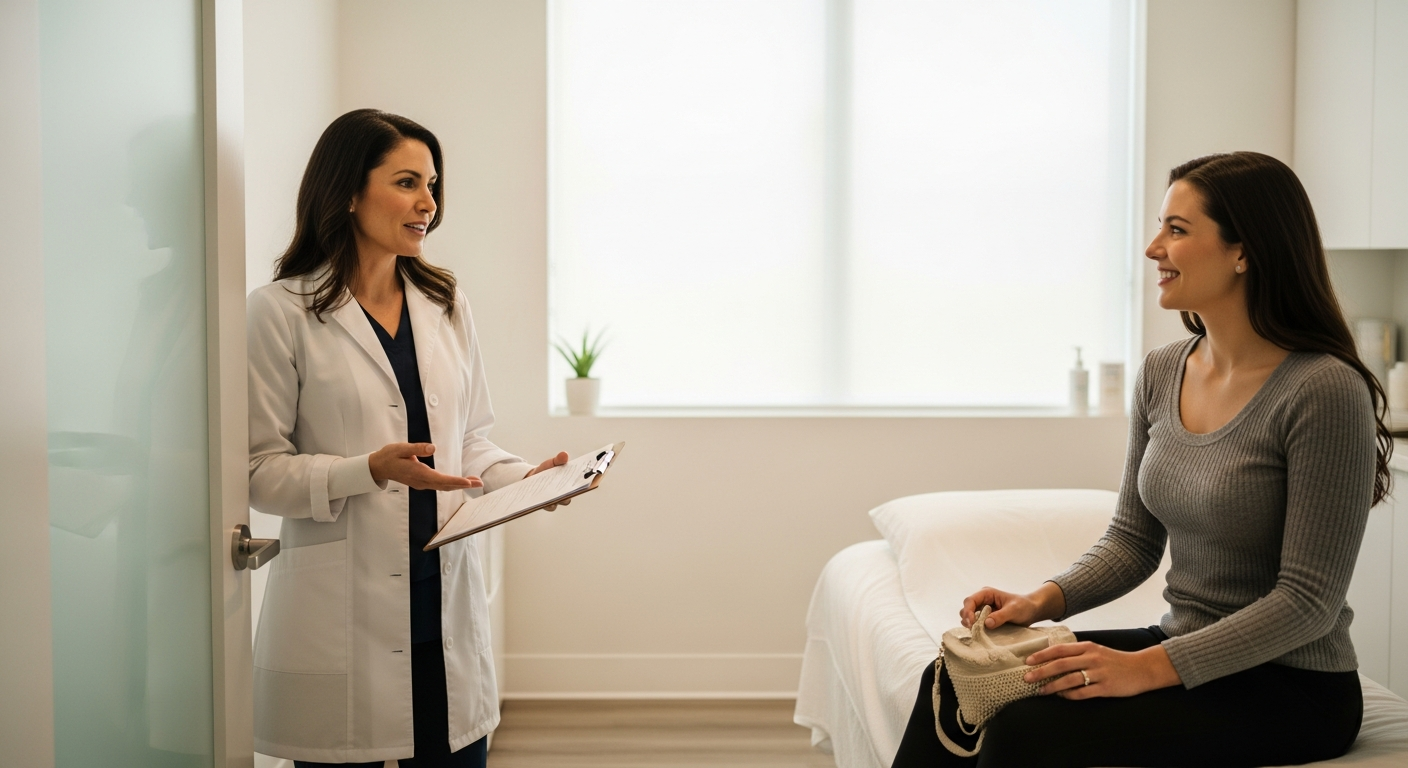
Before the client reaches the front desk, the provider sets the expectation: "Based on what we did today, I want to see you in about 6 weeks. When does that work for you?"
Not "do you want to book again?" Not a suggestion. A direct, specific recommendation with a timeframe.
This framing matters more than most owners realize. "Do you want to book again?" is an optional question. It requires the client to make a decision. "I want to see you in 6 weeks, when works for you?" assumes continuity. It frames the next appointment as a natural next step in their treatment plan, not a purchase decision.
When rebooking is offered at checkout as a natural part of the conversation, not as a sales ask but as care continuity, you'll see 70 to 80% take rates. When you wait for the client to call on her own, that number drops to 40 to 50%.
That gap is entirely your retention problem. Every point in that spread is a client you could have kept.
2. A 72-hour follow-up message
For every client who doesn't book at checkout, there's a second chance: the follow-up message in the first three days.
It doesn't have to be complex. A simple, personal message from the clinic: "Hey [name], how's your skin feeling after Thursday? Dr. Kim mentioned she'd love to see you back in 6 weeks to continue the series. Here's a direct link to book." That message gets read, gets responded to, and gets appointments on the calendar.
The message needs to come from a real person's name, reference the actual visit, and contain a direct booking link. That's it. Not a newsletter. Not a promo. A specific follow-up tied to the specific client and the specific visit.
A lot of clinics have automated email sequences that go out after every appointment. That's not this. Automated sequences feel automated. Clients see through them. What works is a message that reads like it came from a person who actually treated this specific client and is specifically asking them to come back. Even if it's a template, it needs to sound like it wasn't.
Why Most Clinics Don't Have This System
It's not because they haven't thought of it. Every owner I've talked to knows rebooking is important.
It's because no one wrote it down.
The checkout rebooking conversation depends on the provider. Some do it naturally. Some forget. Some feel awkward asking. Without a written protocol that's part of the visit flow, it's inconsistent. Which means it's effectively not a system. It's a habit some people have and some people don't.
Same with the follow-up message. If it's not someone's documented job to send it within 72 hours of every appointment, it doesn't get sent. Front desk staff are busy. The system doesn't exist, so the follow-up doesn't happen, and the client moves on.
This is the pattern I see consistently across clinics at every size. The owners who are frustrated by retention aren't doing bad work. They're running on tribal knowledge instead of documented process. The providers who naturally rebook have strong retention in their own books. The ones who don't are leaving half their clients behind.
The fix is documentation, not motivation.
Write the checkout script. Put it in the provider's end-of-visit checklist. Write the follow-up message template. Assign ownership to a specific role. Set the timing. Track completion.
When you do that, you stop relying on individuals to remember a behavior and start relying on a process. Processes are consistent. Individuals aren't.
The 30-Day Close
Here's what I've seen work when clinics install this system cleanly.
Within 30 days, rebooking rates at checkout move from inconsistent (30 to 50%) to consistent (65 to 75%). Not because providers got better at selling. Because the conversation became expected instead of optional.
The 72-hour follow-up catches another layer, typically 15 to 20% of clients who didn't book at checkout. Not all of them convert, but enough to move the needle.
The combined result is a retention rate that goes from industry average to well above it. The 14-point gap between 47% and 61% is mostly closed with these two changes.
That's not a marketing problem. That's not a treatment quality problem. That's a documented process that either exists or doesn't.
What I tell owners who want to implement this: don't try to do it all at once. Start with the checkout script. Get that locked in first. Make the rebooking conversation a non-negotiable step in the visit, like the pre-treatment consent form. Once it's a reflex, layer in the follow-up message. Assign one person to own it. Check completion weekly for the first month.
Thirty days later, pull your rebooking rate. Compare it to where you started. The number will tell you whether the system is working.
What This Means for Your Revenue
Let's make it concrete.
If your clinic sees 100 unique clients per month and has a 47% retention rate, 53 of them don't come back. At an average ticket of $350, that's $18,550 in potential monthly revenue you're not capturing from people who already trust you.
Getting from 47% to 61% retention means keeping 14 more clients per month. That's $4,900 in additional monthly revenue from existing clients. No new leads. No new ads. No new staff.
That number compounds. Those 14 clients, retained over a year, represent $58,800 in revenue you're currently leaving on the table. And that's before you account for increased treatment frequency, upsells, or referrals from clients who stay long enough to become regulars.
This is why increasing patient retention by just 5% can boost profits 25% to 95%, according to American Med Spa Association data. The math on client retention is dramatically better than the math on new client acquisition. You've already paid to acquire these clients. Keeping them is almost free.
Most owners are looking at their marketing spend trying to fix a retention problem. Those are two different levers. Both matter. But if you're running at 47% retention, fix the retention system first. The marketing ROI will look completely different when the clients you're paying to acquire actually come back.
The Short Version
If clients are leaving happy and not coming back, the issue isn't your treatment quality.
It's that you have no system for what happens in the 72 hours after they walk out.
The fix: a checkout rebooking protocol and a 72-hour follow-up message. Both written down. Both assigned to a specific role. Both tracked.
That's it. You can build this in a day. You'll see the first results in 30 days.
The 14-point gap between clinics that do this and clinics that don't isn't a gap in skill or service quality. It's a gap in documentation. The system either exists or it doesn't. Right now, for most clinics, it doesn't.
FAQ
Why do medspa clients not come back after their first visit? Most of the time, it's not dissatisfaction. Clients who had a positive experience still don't rebook because no one created a specific, structured moment for it. Without a checkout rebooking conversation or a timely follow-up, they default to "I'll book when I need it" and that moment rarely comes. The disappearing happy client is a systems gap, not a quality gap.
What is the average retention rate for a med spa? Industry data from workee.ai puts the average at approximately 47%. Clinics with active follow-up systems consistently reach 61% and above. That 14-point gap is largely explained by one thing: whether the clinic has a documented post-visit system or doesn't. Most clinics doing well on retention aren't smarter or more attentive, they're more systematized.
How do I increase my medspa rebooking rate? Start with two changes. First, a scripted rebooking conversation at checkout where the provider makes a specific recommendation with a timeframe. Not a question, a recommendation. Second, a 72-hour follow-up message for anyone who didn't book at checkout, tied to the specific visit. Together, these close the 47%-to-61% gap for most clinics within 30 days.
What should a medspa do in the 72 hours after a client visit? Send a personal follow-up message that references the specific visit, names the provider, states a recommended return timeframe, and includes a direct booking link. It should read as a message from a person, not an automated promotion. Within 72 hours is the window when the positive treatment experience is still fresh and the client is most likely to rebook. Waiting longer means the window closes.
What is a medspa rebooking protocol at checkout? A checkout rebooking protocol is a documented, scripted step at the end of every appointment where the provider makes a specific, direct rebooking recommendation before the client leaves. It's framed as care continuity, not a sales ask. "Based on what we did today, I'd like to see you in 6 weeks" produces 70 to 80% rebooking rates, compared to 40 to 50% when clients are left to self-schedule. The protocol must be written, assigned, and tracked to be consistent.
Your Retention Rate Is a Process Problem. Dart Can Help You Fix It.
Want to know your actual rebooking rate and where the drop-off is happening in your specific clinic? Ask Dart, it'll walk through your numbers and tell you exactly where to focus first.
Ask Dart about your retention metrics →
Sources: workee.ai/blog/med-spa-booking-statistics; americanmedspa.org; pabau.com/blog/med-spa-marketing-strategies; Reddit r/MedSpa
Want frameworks like these calibrated to your clinic?
Find my biggest leak